
Optimizing Preventive Rail Grinding on India’s Dedicated Freight Corridors
By Jeff Tuzik
In India, rail freight traffic is increasing rapidly. To accommodate the growth, the government has funded and overseen the ongoing construction of dedicated freight corridors in high-traffic-density regions. For the two corridors now in operation, there is a new focus on developing and implementing an optimal rail maintenance strategy. Unfortunately, there is no off-the-shelf solution. Maintaining the rail means first studying how the rail performs.
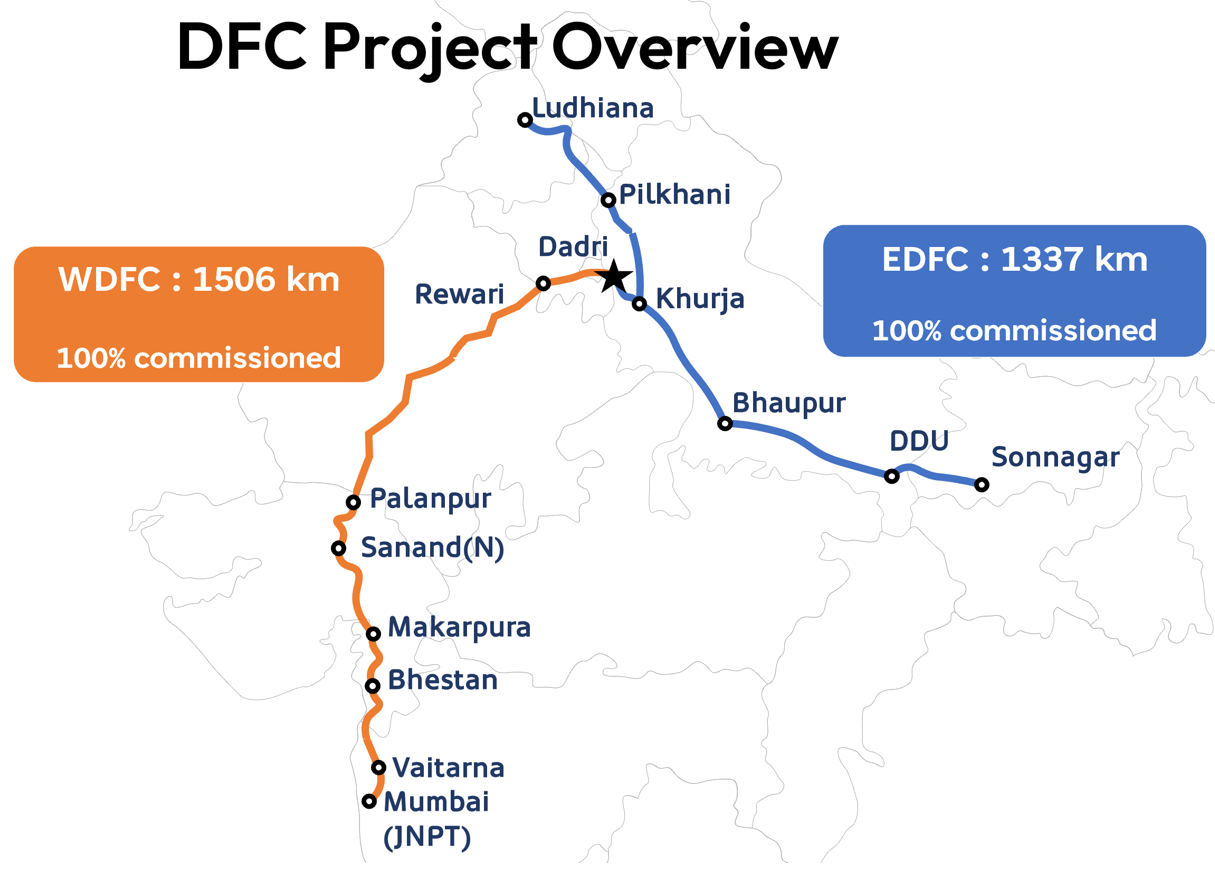
In the early 2000s, as part of India’s 10th Five Year Plan, the Planning Commission proposed construction of a series of Dedicated Freight Corridors (DFC) to accommodate rapidly increasing nationwide freight traffic, and to improve shipping costs, service, and reliability by separating freight traffic from passenger traffic along heavily trafficked routes. The proposal gained momentum quickly. India’s Ministry of Railways and the government-owned Dedicated Freight Corridor Corporation of India Ltd. soon began construction on two Dedicated Freight Corridors, the Western and the Eastern (see Figure 1).
The DFCs began operations in 2021 and as of 2026, both are fully commissioned. “The DFC project is the most iconic rail project in India, post-Independence,” Praveen Kumar, Managing Director of the Dedicated Freight Corridor Corporation of India Ltd. (DFCCIL), told colleagues at the 2026 Wheel Rail Seminars Heavy Haul Conference.
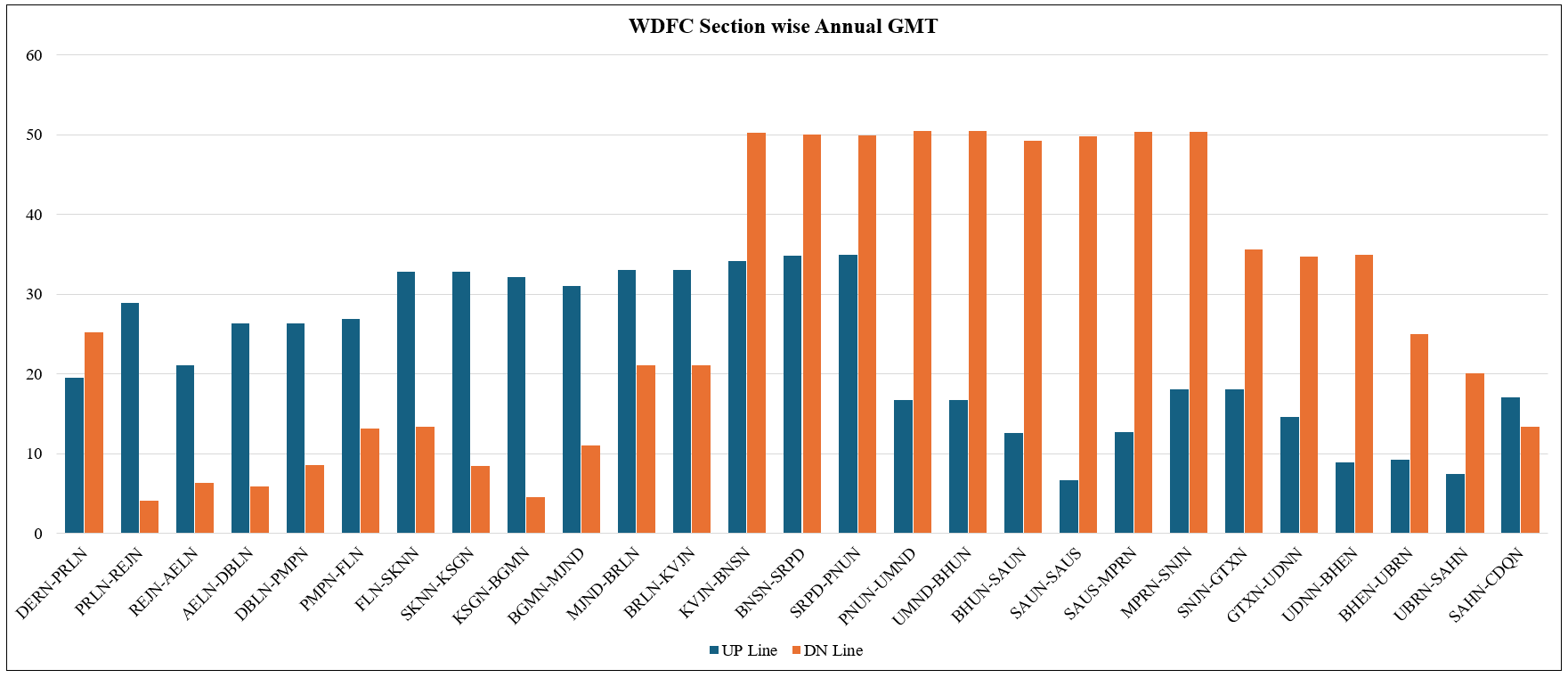
The Western DFC comprises just over 1500 route-kilometers of track. It was designed for 32.5-ton axle loads and ≈20,000-ton trains (primarily double stacks) operating at average speeds of ≈100 km/h. Both corridors are electrified via overhead catenary. The Western DFC is also the subject of an ongoing study to determine rail wear rates, damage accumulation rates, and the optimal rail grinding frequency for the head-hardened rail (1080 HH UIC60) that is used throughout the corridor. Traffic on the corridor has increased rapidly since it went into service—from less than 10 annual MGT to nearly 75 annual MGT in the heaviest-trafficked track sections, Kumar said. Figure 2 shows the Western DFC in terms of MGT per track-kilometer as of early 2026 (note, these are metric tons). A similar study was also conducted on the Eastern DFC, but the traffic and rail characteristics there are different. The Eastern corridor currently sees higher annual MGT, but lower axle loads, lighter trains. It was not built with head-hardened rail; it uses standard rail (R260 UIC60).
One 72-stone grinder is currently used to manage the entire DFC grinding program, a total of 2843 route-kilometers. Guidelines from the Research Design and Standards Organization, part of the Ministry of Railways, initially indicated that the Western DFC should be ground every 25 MGT, Kumar said. This hasn’t been feasible, and deferred grinding has begun to pile up. “We know our grinding ‘fleet’ is insufficient. We can’t hit the theoretically ideal grinding cycle. We need to know how that’s affecting the rail, and how we should adjust our grinding cycle to something more optimized for our capability and our system,” he said.
“With the DFC still young, we had a rare chance to build our maintenance strategy on our own performance data rather than inherited assumptions,” Kumar said. DFCCIL therefore commissioned a study of the Western DFC focused on wear (initially), and specifically how wear and damage rates accelerated over time as additional grinding cycles were deferred. “We were the first to grind the Western DFC, so we had natural wear and MGT data leading up to the first grind, and of course wear and MGT after grinding to use for comparison,” said Yash Sehgal, Technical Director at Vandhana International Pvt. Ltd., the O&M service provider contracted to manage the DFC grinding program.
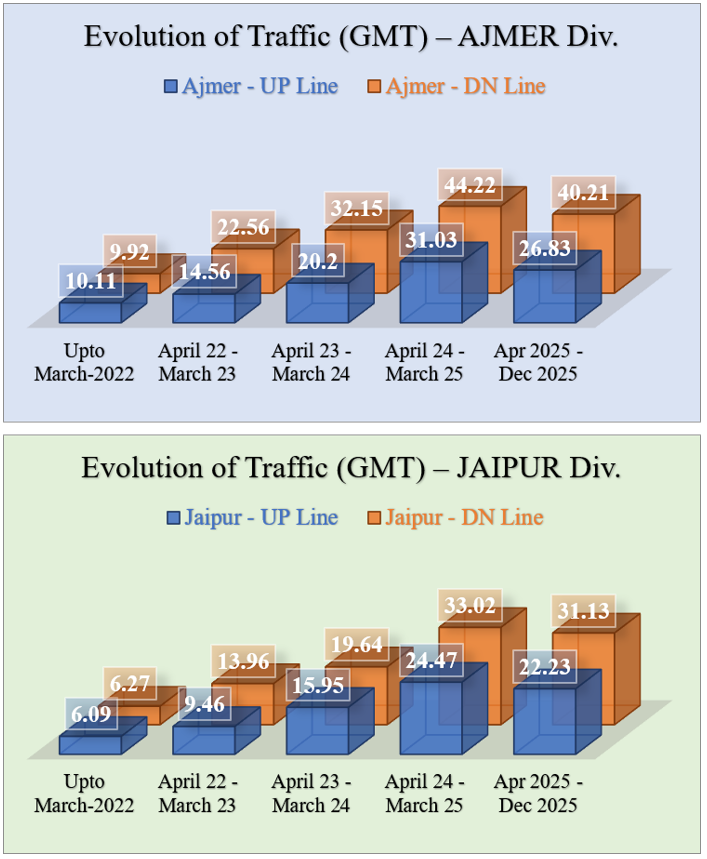
Figure 3 shows annual MGT for two divisions on the Western DFC from when the corridor opened until the end of 2025 (note that the ’25 – ’26 fiscal year had not ended when this data was presented, but the MGT is expected to surpass the 2024 –2025 figures). “What the data shows is that a lot of traffic is migrating from the Indian Railways routes to the DFC, and that is projected to continue to increase for some time,” Kumar said. “As we add sections to connect the ports, we expect that trend to accelerate.”
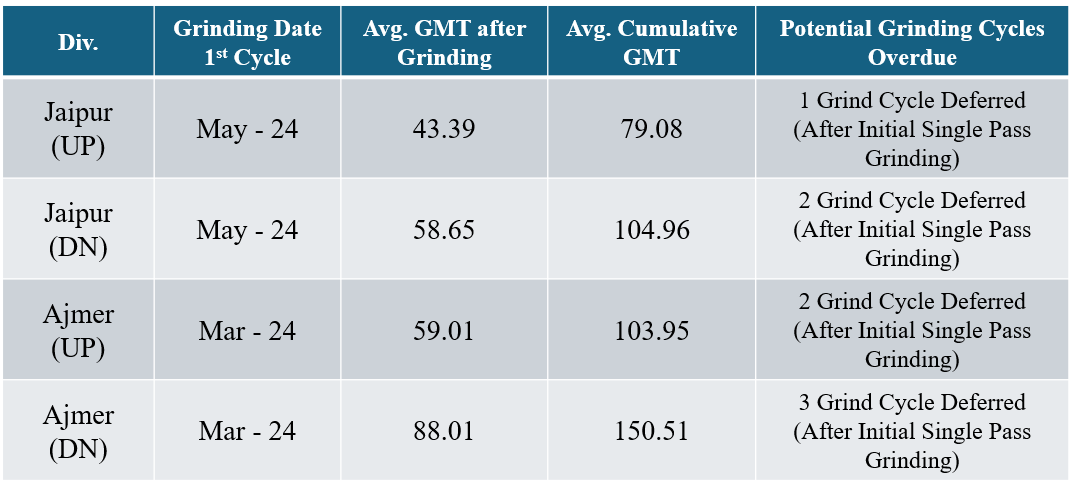
Figure 4 shows when Jaipur and Ajmer divisions were first ground (May of 2024 and March of 2024, respectively) and the average cumulative MGT that has accrued since rail grinding (center column). Ajmer DN (down/southbound), for example, has an average MGT of 88.01 since grinding, meaning that three (recommended) 25 MGT grinding cycles have been bypassed or deferred. Because it had the highest post-grind MGT in the data set, Ajmer DN was selected for further wear-rate analysis.
The DFCCIL/Vandhana team selected three 2.5-degree curves for further study. Each curve was measured five times after the initial (and only) rail grinding was done: at 22, 44, 60, 74, and 88 MGT. The measurements refer to cumulative MGT accrued after grinding (i.e. within the deferred-grinding window).
Test Sites and Takeaways
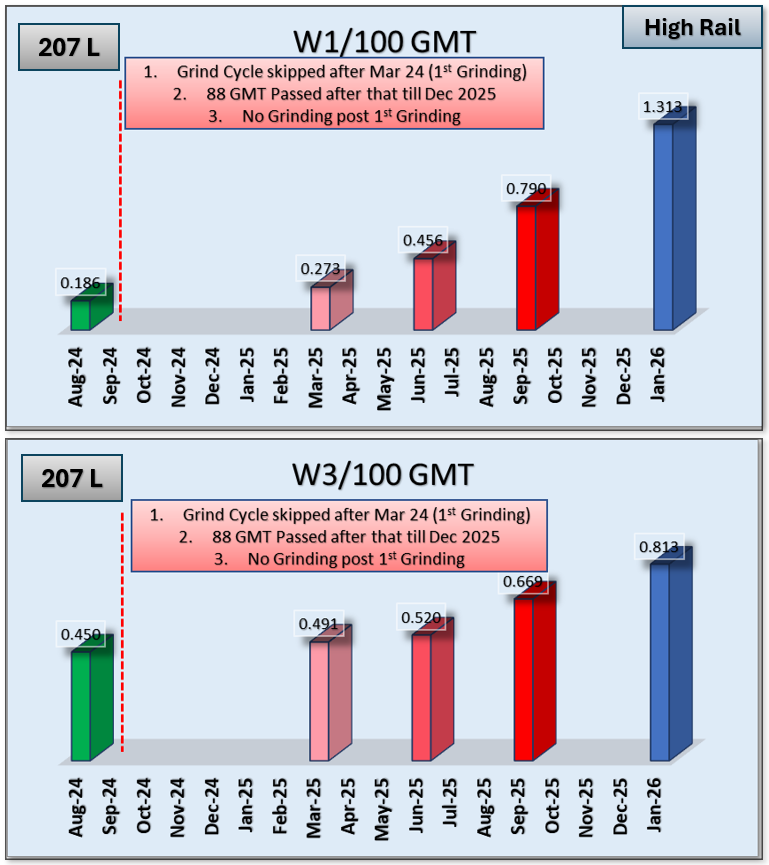
Figure 5 shows the wear rate on the high rail (millimeters per 100 MGT) at site 1: curve 207 Left. The top graph shows vertical wear, and the bottom graph shows gage wear (as measured at 45-degrees). At 22 MGT post-grinding, the average vertical wear rate is 0.186. By the time of the final measurement at 88 MGT post-grinding, the wear rate is 1.313. A huge increase in the wear rate in itself (≈600%), but the graph also illustrates that the increase is not linear, but elliptical; wear rate clearly accelerates as post-grind MGTs accrue. “We saw a similar pattern at all three test sites on both high and low rails,” Sehgal said.
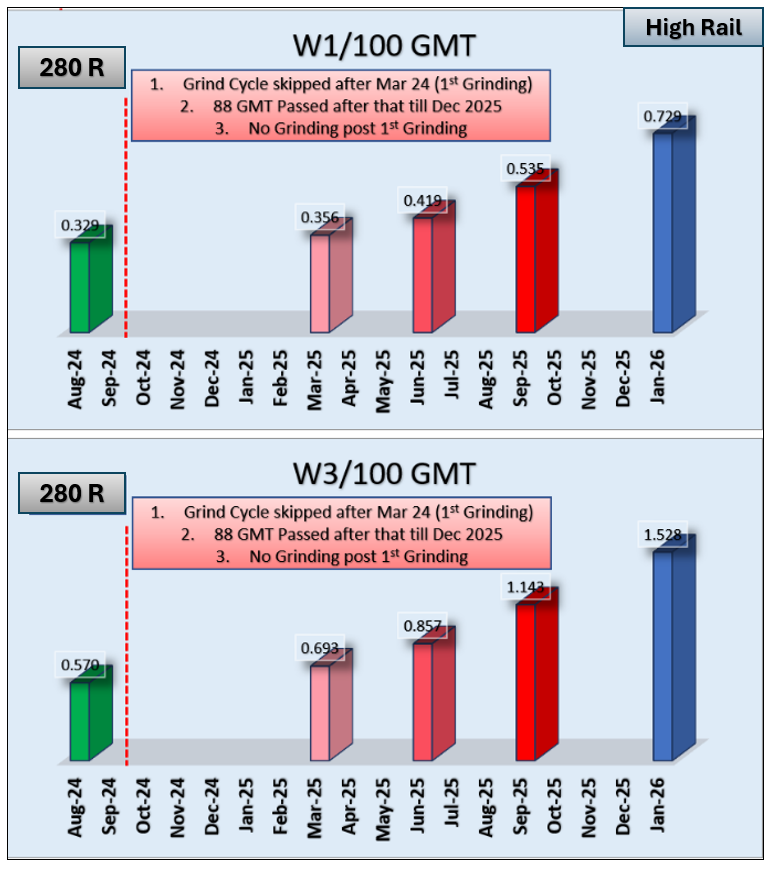
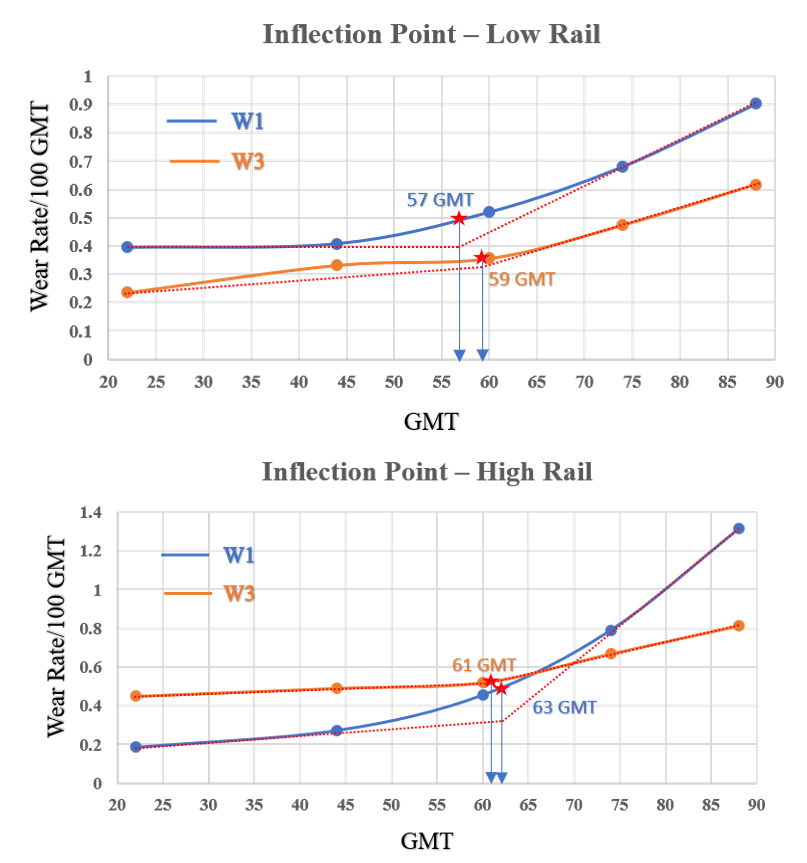
Figure 6 shows high-rail wear rate data from site 2: curve 280 Right. Both vertical and gage wear show the same accelerating trend as seen at site 1. For example, the vertical wear rate at site 2 increases from measurement 2 to 3 by 17.8%, From 3 to 4 by 27.5%, from 4 to 5 by 36.3%. Data from site 3 follows a similar trend. But an accelerating rate of wear is hardly novel or unexpected. DFCCIL and Vandhana wanted to find the inflection point in the wear rate data in order to determine the functional and practical limits of deferring rail grinding. “When do we hit the point where we’re causing more damage to the rail by not grinding than we can fix through preventive rail grinding?” Sehgal said.
Figure 7 shows wear rate versus MGT for the low and high rails at site 1 (curve 207 L). On both rails wear rates increase sharply at 60 MGT post-grinding, on average. “We were surprised to see how closely correlated the data was across the high rails and low rails, vertical and gage [wear], and from site to site,” Sehgal said. Sites 2 and 3 had average inflection points of 63.25 MGT and 64 MGT respectively. The inflection points mark the last point for effective preventive rail grinding. And since Ajmer is the heaviest-trafficked division on the Western DFC, the findings indicate that a preventive grinding cycle of ≈60 MGT is effective and more practical than a 25 MGT cycle, Sehgal said. For Kumar, the result reframes how DFCCIL plans its fleet and cycles: “A consistent inflection point in the degradation curve gives us a defensible framework for setting grinding intervals, instead of holding to a fixed 25 MGT band we can’t realistically meet across the network,” he said.
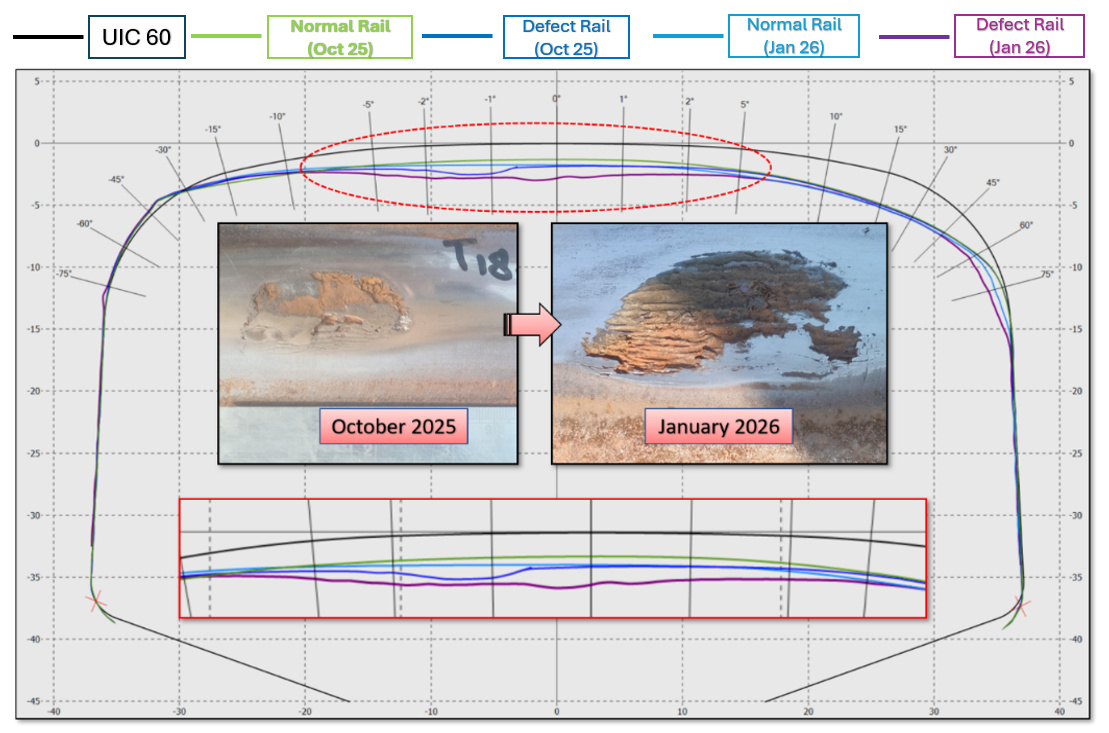
The study also provided the opportunity to monitor several rail defects, primarily RCF damage, over time and in the absence of grinding intervention. Figure 8 shows a patch of RCF damage on the Ajmer division that has begun to spall out, transposed over multiple rail profile measurements. The light green profile is undamaged rail as measured several inches away from the spalling. The dark blue profile is the rail as measured directly on the defect at the same time. The light blue profile showed the undamaged rail as measured 4 months later, and the purple profile shows the corresponding measurement at the defect. The difference between the undamaged profiles taken four months apart is minor, showing only a small amount of vertical and gage wear. But the defect measurements show significant differences, both in terms of defect shape and material loss and terms of profile shape. The fact that defects can grow so much in such a short time may indicate the need for a tighter, sub-60 MGT grinding cycle. “We have to codify and quantify defect damage so we can include it in our inflection point preventive grinding model,” Sehgal said.
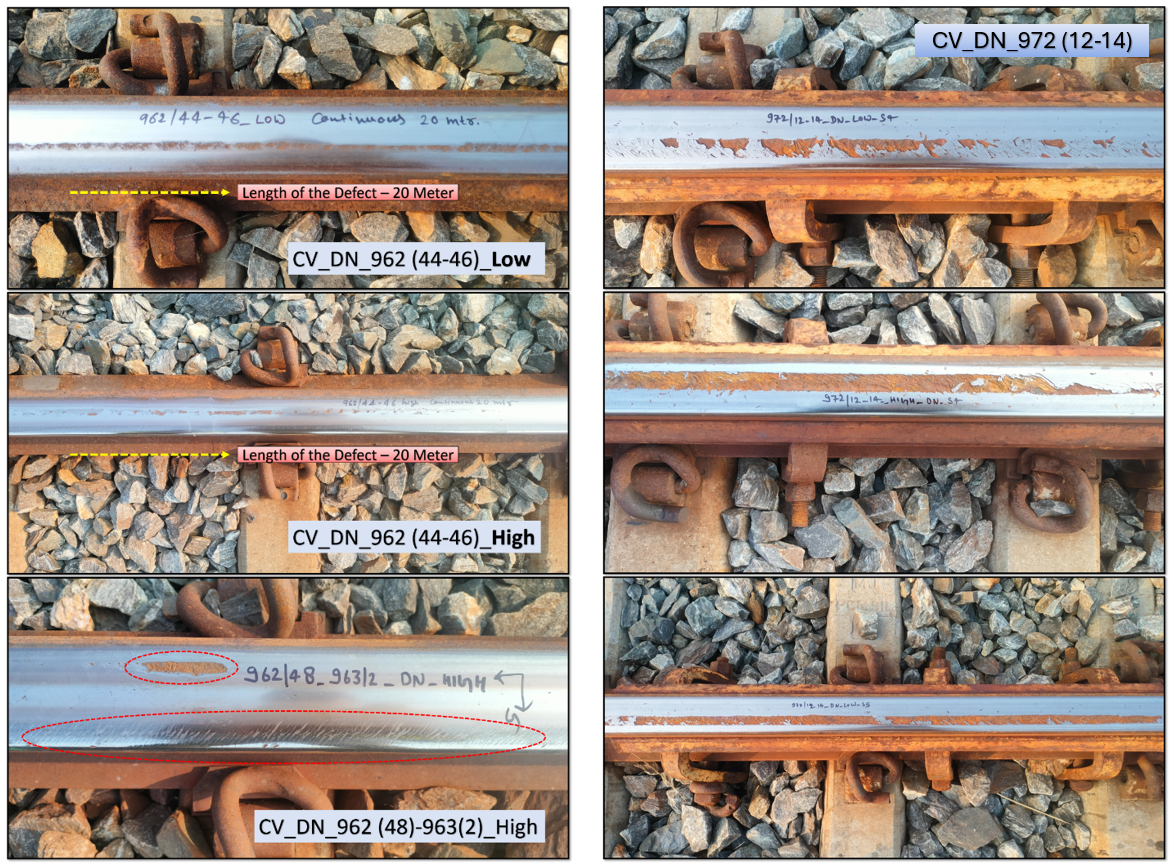
The longer RCF damage goes unaddressed, the more it tends to spread. Deferred grinding on the Western DFC caused many seemingly-isolated patches of RCF link together into 30-plus-meter bands of spalled-out material, Sehgal said (see Figure 9). This is a phenomenon seen elsewhere, particularly in head-hardened rail. “We need more data to determine if this is something that we can address with regular cyclical grinding or if it’s something we have to proactively target with a smaller or more specialized grinder.”
Based on wear data alone, the Western DFC study shows that preventive rail grinding is effective on the system at 60 MGT intervals. As RCF and defect generation/propagation rates are folded into this data, the inflection point may shift. “Wear alone can’t set our grinding frequency—we have to account for RCF, surface defects and defect generation rates from ultrasonic testing,” Kumar said. Future phases of the study will incorporate top-of-rail lubrication to assess its influence on wear rates, rolling contact fatigue (RCF) and long-term rail life, Praveen Kumar said. DFCCIL is also expanding its grinding fleet to include a 20-stone grinder for more-targeted grinding operations (such as surface defect remediation) and a 96-stone grinder to support cyclical grinding as systemwide MGT increases. “We’re already working with our partners to consolidate our data and analytics, whether its wear data or grind quality index or defects, so we can continue to adjust our maintenance cycles,” he said.
India’s dedicated freight corridors present an opportunity to dial-in and establish optimal maintenance practices on a new system. They’re a meeting ground for theory and practical application, where DFCCIL seems eager to test and validate best practices for their unique railroad environment. As traffic increases and additional DFC lines are constructed, knowledge gained from studies like these will be invaluable moving forward.

Jeff Tuzik is Managing Editor of Interface Journal
This article is based presentations made at the 2026 Wheel/Rail Interaction Heavy Haul.
Images are courtesy of the Dedicated Freight Corridor Corporation of India Ltd.