Interface Journal
The Journal of Wheel/Rail Interaction
Interface Journal
Navigation
  • Home
  • About Interface
  • Contact
  • Wheel Rail Seminars
  • Advertisement & Sponsorship
You are here: Home › Wheel/Rail Interaction › Page 6
Currently browsing category

Wheel/Rail Interaction

Managing Wheel/Rail Interaction on Rail Transit Systems

January 4, 2014 | Filed under: Rail Grinding, Rail Transit, Vehicle/Track, Wheel Maintenance, Wheel/Rail Interaction

By Bob Tuzik • January, 2008 All railways must deal with operating/engineering and vehicle/track interaction issues. But rail transit systems, which operate under the microscope of the urban environment, face special, often unique, challenges. Speakers at Rail Transit ’07, Advanced Rail Management and Interface Journal’s third seminar devoted to wheel/rail interaction on rail …

Slide5

Tools and Techniques for Optimizing the Wheel/Rail Interface

January 4, 2014 | Filed under: Measurement Systems, Rail Grinding, Vehicle/Track, Wheel/Rail Interaction, Wheel/Rail Profile

By Gary P. Wolf • July, 2007 Much has been written and said about the need to optimize the interface between the wheel and rail, but with the growth of heavy axle load traffic, the mandate for optimum performance is greater than ever. Balancing the wheel/rail equation and optimizing interaction can …

Tuning in to the Systems Approach

January 4, 2014 | Filed under: Vehicle/Track, Wheel/Rail Interaction

By Bob Tuzik • July, 2007 You’ve heard it before, you’ll hear it again. Delegates to the 13th Annual Wheel/Rail Interaction Seminar presented by Interface Journaland Advanced Rail Management heard it time and again over the course of the seminar: The wheel/rail interface is a system. And when there are problems, as …

Fig4

Specialized Rail Profile Grinding on MBTA

January 3, 2014 | Filed under: Rail Grinding, Rail Maintenance, Rail Transit, Wheel/Rail Interaction, Wheel/Rail Profile

by Bob Tuzik • April 10, 2005 Rail Grinding has been used to solve a host of problems on transit systems. It recently was used in Boston to remove a new wrinkle. A specialized grinding program was initiated in 2002 on the heels of a series of light-rail derailments on the …

Flange Climb and Independently Rotating Wheels

January 3, 2014 | Filed under: Rail Transit, Vehicle/Track, Wheel/Rail Interaction, Wheel/Rail Profile

by Bob Tuzik, December 1, 2004 Investigations have shown that wheel-flange/gauge-face angle and the coefficient of friction (COF) play significant roles in contributing to or preventing flange-climb derailments. Investigations have also shown that Light Rail Vehicles with Independently Rotating Wheels (IRWs) have a greater propensity for flange-climb derailment than vehicles with conventional …
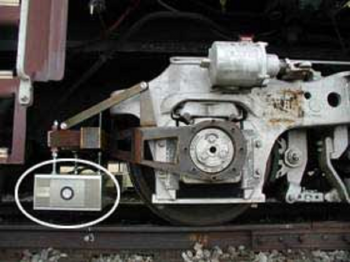
Examining wheel/rail interaction on rail transit systems

January 3, 2014 | Filed under: Friction Management, Gary Wolf, Noise and Vibration, Rail Grinding, Rail Transit, Wheel Maintenance, Wheel/Rail Interaction

By Bob Tuzik • November 4, 2004 If the first unwritten rule in optimizing the wheel/rail interface on rail transit is: Know your system; the second rule should be: Recognize that the w/r interface is a system. “No single department can attack the issues in isolation and expect to get very far,” Joseph Oriolo, Senior …

Optimizing Wheel and Rail Profiles on Amtrak’s Northeast Corridor

December 30, 2013 | Filed under: Rail Grinding, Rail Transit, Wheel/Rail Interaction, Wheel/Rail Profile

by Eric E. Magel • September 20, 2004 Wheel wear is an inevitable byproduct of wheel/rail interaction. Excessive wear, however, indicates an imbalance in some aspect of the wheel/rail interface. Amtrak’s high-speed Acela trains, running on track with much greater curvature than other high-speed systems, were quickly found to exhibit very …

Featured

Management of the Wheel/Rail Contact Interface in Heavy-Haul Operations (Part 1 of 2)

October 18, 2013 | Filed under: Friction Management, Heavy Haul, Rail Grinding, Wheel Maintenance, Wheel/Rail Interaction

By Huimin Wu and Semih Kalay • October, 2009 Wear and rolling contact fatigue (RCF) of rails and wheels are common problems under heavy-haul operations. Increasing axle loads can increase the capacity of a railway system, but also can increase the stress state of the system. A root cause of RCF …

Fig1 440x510

Management of the Wheel/Rail Contact Interface in Heavy-Haul Operations (Part 2 of 2)

October 18, 2013 | Filed under: Friction Management, Heavy Haul, Rail Grinding, Wheel Maintenance, Wheel/Rail Interaction

By Huimin Wu and Semih Kalay • January 2010 See Part 1 of this article here. What are the differences between rail shapes that produce higher contact conicities and those that produce lower contact conicities? The profiles shown in Figures 1a and 1b illustrate the differences that can result in significant …

Photo 600x400

Engineering the Wheel/Rail Interface for Rail Transit

October 18, 2013 | Filed under: Rail Transit, Track Geometry, Vehicle Design, Vehicle/Track, Wheel/Rail Interaction

By Jeff Tuzik • July 2010 Wheel/rail interaction is complex, variable and difficult to manage — especially on rail transit systems where noise, vibration and ride quality present daily challenges. As a result, managing the wheel/rail interface requires constant attention and innovation. Speakers at Advanced Rail Management’s Rail Transit 2010 …

← Previous Page
Next Page →

Search by Category

Related Articles

  • Examining wheel/rail interaction on rail transit systems
    In relation to
    Friction Management
  • WRI 2014 Transit: A Systems Approach to Wheel/Rail Interaction
    In relation to
    Friction Management
  • WRI 2015: Transit — Maintenance and the State of Good Repair
    In relation to
    Friction Management
  • Managing Wheel/Rail Interaction on Rail Transit Systems
    In relation to
    Rail Grinding
  • WRI 2017 – Transit: System Optimization and Better Asset Management
    In relation to
    Rail Transit

Sponsors

ENSCO
Hollandlogo

© 2026 Interface Journal


Loading Comments...