Interface Journal
The Journal of Wheel/Rail Interaction
Interface Journal
Navigation
  • Home
  • About Interface
  • Contact
  • Wheel Rail Seminars
  • Sponsorship
You are here: Home › Page 9

WRI 2014 Transit: A Systems Approach to Wheel/Rail Interaction

June 29, 2014 | Filed under: Friction Management, Measurement Systems, Noise and Vibration, Rail Grinding, Rail Transit, Vehicle/Track, Wheel/Rail Interaction

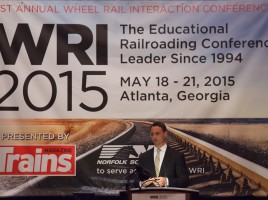
by Jeff Tuzik   The 20th annual Wheel/Rail Interaction Conference drew a record number of attendees and speakers from around the world. They came to contribute to and draw from the growing body of knowledge on wheel/rail interaction. Since the conference began 20 years ago, the industry has come a …

Measuring With Eddy Current: Gage Corner Cracking and the Magic Wear Rate

May 25, 2014 | Filed under: Measurement Systems, Rail Maintenance, Wheel/Rail Interaction

By Ryan McWilliams and Eric Eberius Gage corner cracking (GCC) of the rail from rolling contact fatigue (RCF) is a dangerous and costly form of rail damage. Unfortunately, it’s also notoriously difficult to measure. And as GCC becomes more prevalent on rail systems around the world, accurate measurement is an …

Controlling Rail Cant and Lateral Forces by Managing the Wheel/Rail Interface

May 20, 2014 | Filed under: Rail Cant, Rail Maintenance, Track Geometry

by Brad Kerchof and Huimin Wu Railroad track people know that track degradation is a complex and constant problem. Because so many variables affect track strength, correcting problems when they arise, and correcting them effectively, is no easy task. Norfolk Southern’s Research and Tests Department recently concluded a series of tests …

Taking the Long View: 20 Years of Wheel/Rail Interaction (Part 2 of 2)

April 22, 2014 | Filed under: Friction Management, Gary Wolf, Heavy Haul, Measurement Systems, Rail Maintenance, Track Geometry, Vehicle/Track, Wheel/Rail Interaction

Part 2. Friction Management, Vehicle Suspension and Measurement Systems By Bob Tuzik, April 2014 Part 1 of this article explored advances in metallurgy, wheel/rail profile design and maintenance practices. Part 2 continues the theme, examining the technologies and techniques that have shaped our understanding of wheel/rail interaction. While the practice of …

What Kind of Rail Materials Will Survive in Heavy-Haul Service? (Part 1 of 2)

January 29, 2014 | Filed under: Heavy Haul

By James R. Hornaday, Jr. In many ways, rail is the most important component in a railroad system. The economic value of installed rail is usually the most costly asset listed in any railroad’s financial accounts. The financial stability of a railroad is often determined by how well that installed …

Truck Warp: The Causes and Cures (Part 1 of 2)

January 29, 2014 | Filed under: Vehicle/Track

By Gary P. Wolf Whether you are primarily interested in the track or the vehicle side of the wheel/rail interface, the effects of “truck warp” should be of interest to you. This two-part article examines the impact of warp in the overall operating environment. Part 1 examines what truck warp …

Applying Quality Concepts to the Wheel/Rail Interface (Part 3 of 3)

January 29, 2014 | Filed under: Rail Grinding, Rail Maintenance

By Stephen S. Woody Part 1 of this article examined the results of a six-sigma project that Norfolk Southern initiated to improve the efficiency of its grinding program. Part 2 illustrated some the data analysis-related problems that NS experienced and learned from during other six-sigma projects. Part 3 describes two ideas …

Taking the Long View: 20 Years of Wheel/Rail Interaction (Part 1 of 2)

January 8, 2014 | Filed under: Gary Wolf, Rail Grinding, Track Geometry, Wheel/Rail Interaction, Wheel/Rail Profile

Part 1. Metallurgy, Wheel/Rail Profile Design and Maintenance. by Bob Tuzik, January 2014 Ask a group of railroaders, researchers or suppliers what the essential aspects of understanding wheel/rail interaction have been over the past 20 years, and you’ll get a host of answers. But among them, major categories consistently emerge: …

Using Performance-Based Assessment of Reserve Gauge Strength to Enhance Tie-Replacement Planning

January 4, 2014 | Filed under: Track Geometry

By Robert Madderom Technology has changed the ways in which railroads plan most of their maintenance programs over the past 30 years. But one aspect of maintenance planning has remained static. Railways still select ties for replacement and plan a significant portion of their maintenance budgets based on visual inspections by …

What Kind of Rail Materials Will Survive in Heavy-Haul Service? (Part 2 of 2)

January 4, 2014 | Filed under: Heavy Haul

By James R. Hornaday, Jr. See Part 1 of this article. Contrary to many railroaders’ and rail mills’ opinions, there are no innocuous inclusions in rail. Any simple oxide particle, any complex oxide particle, any sulfide particle, or any complex oxide-sulfide particle in a rail will initiate a crack in …

← Previous Page
Next Page →

Search by Category

Related Articles

  • What Kind of Rail Materials Will Survive in Heavy-Haul Service? (Part 1 of 2)
    In relation to
    Heavy Haul
  • Investigating Wear and Damage Mechanisms
    In relation to
    Wheel/Rail Interaction
  • Studs: Squat-Type Defects that are Misunderstood and Mismanaged
    In relation to
    Rail Maintenance
  • Management of the Wheel/Rail Contact Interface in Heavy-Haul Operations (Part 1 of 2)
    In relation to
    Friction Management
  • Understanding Stresses in Rails (Part 2 of 2)
    In relation to
    Rail Maintenance

Sponsors

ENSCO

© 2026 Interface Journal


Loading Comments...