Interface Journal
The Journal of Wheel/Rail Interaction
Interface Journal
Navigation
  • Home
  • About Interface
  • Contact
  • Wheel Rail Seminars
  • Advertisement & Sponsorship
You are here: Home › Measurement Systems › Page 3
Currently browsing category

Measurement Systems

Longview2

Taking the Long View: 20 Years of Wheel/Rail Interaction (Part 2 of 2)

April 22, 2014 | Filed under: Friction Management, Heavy Haul, Measurement Systems, Rail Maintenance, Track Geometry, Vehicle/Track, Wheel/Rail Interaction

Part 2. Friction Management, Vehicle Suspension and Measurement Systems By Bob Tuzik, April 2014 Part 1 of this article explored advances in metallurgy, wheel/rail profile design and maintenance practices. Part 2 continues the theme, examining the technologies and techniques that have shaped our understanding of wheel/rail interaction. While the practice of …
Photo 500x415

Meeting the Industry’s Technology Goals

January 4, 2014 | Filed under: Friction Management, Measurement Systems, Wheel/Rail Interaction

by Bob Tuzik, January, 2008 The wheel/rail interface must be managed in order to increase the life of rail and rolling stock components and to reduce in-service failures. This was one of the primary messages delivered at the Association of American Railroads/Transportation Technology Center, Inc.’s 14th Annual Research Review. The research …

Fig1

Rail Cant Measurement of Concrete Crossties (Part 2 of 2)

January 4, 2014 | Filed under: Measurement Systems, Rail Cant, Track Geometry

By Arthur Clouse Part 1 of this article examined the mechanisms that cause rail seat abrasion on concrete ties. Part 2 looks at existing standards for concrete ties and the systems that can be used to measure their performance. The Federal Track Safety Standards prescribe minimum track geometry and track structure requirements for specific track …

Fig1 500x375

Rail Seat Abrasion: In-Track Repair

January 4, 2014 | Filed under: Measurement Systems, Rail Cant, Track Geometry

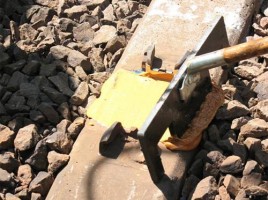
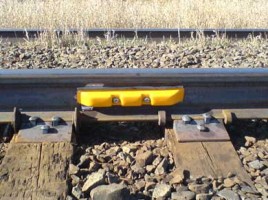
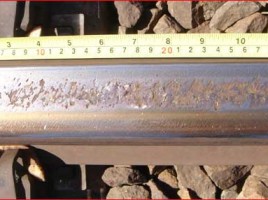
by Bob Tuzik, January, 2009 Rail seat abrasion on concrete ties has plagued railroads for nearly two decades, now. Abrasion ranging from less than 0.02 inches to more than 1 inch began appearing on curves on several of the major North American user railways in the early 1990s. The problem, which …

1

Wheel/Rail Interaction ’08: Data to Information (Part 2 of 2)

January 4, 2014 | Filed under: Friction Management, Measurement Systems, Rail Grinding, Wheel Maintenance, Wheel/Rail Interaction

By Jeff Tuzik • October, 2008 Part 1 of this article examined efforts to optimize vehicle and track component performance through various testing, monitoring and simulation programs. Part 2 continues on the theme of “data to information,” further exploring such programs and the operational benefits they engender. Maintaining a Safe Neutral Temperature (SFT) on …

1 600x300

Rail Cant Measurement of Concrete Crossties (Part 1 of 2)

January 4, 2014 | Filed under: Measurement Systems, Rail Cant, Track Geometry

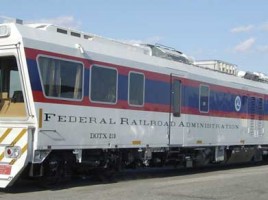
By Arthur Clouse • October, 2008 In response to accidents, unregulated causal factors and the National Transportation Safety Board’s recommendation (NTSB R-06-19), the Federal Railroad Administration (FRA) Office of Safety together with the Office of Research and Development initiated a study to identify and evaluate the safety of concrete crossties. …

3

Wheel/Rail Interaction ’08: Data to Information (Part 1 of 2)

January 4, 2014 | Filed under: Measurement Systems, Rail Grinding, Vehicle/Track, Wheel Maintenance, Wheel/Rail Interaction

By Bob Tuzik • July, 2008 As research into wheel/rail interaction has evolved, the emphasis has moved toward implementation of available technology and conversion of data into information. Such was the case at Wheel/Rail Interaction ’08, the 14th annual seminar produced by Advanced Rail Management and sponsored by Progressive Railroading magazine. Railroaders, researchers …

Implementing Wheel/Rail Measurement and Analysis Technology

January 4, 2014 | Filed under: Measurement Systems, Wheel/Rail Interaction

By Bob Tuzik • July, 2008 Any examination of the systems in use to measure and monitor wheel/rail interaction requires a discussion of the challenges associated with implementing new and emerging technology. Several industry practitioners participated in such a discussion at Advanced Rail Management and Progressive Railroading magazine’s Wheel/Rail Interaction ’08, the 14th …

Reducing Broken Rail Derailments in Dark Territory (Part 1 of 2)

January 4, 2014 | Filed under: Measurement Systems, Rail Maintenance

By Norman Hooper • January, 2008 This article reflects observations made while serving as Chief Engineer of BC Rail, a Class II railway (now owned by Canadian National) during a period in which the railway reduced service failures and broken rail derailments in dark territory by 60% — an improvement …

Slide5

Tools and Techniques for Optimizing the Wheel/Rail Interface

January 4, 2014 | Filed under: Measurement Systems, Rail Grinding, Vehicle/Track, Wheel/Rail Interaction, Wheel/Rail Profile

By Gary P. Wolf • July, 2007 Much has been written and said about the need to optimize the interface between the wheel and rail, but with the growth of heavy axle load traffic, the mandate for optimum performance is greater than ever. Balancing the wheel/rail equation and optimizing interaction can …

← Previous Page
Next Page →

Search by Category

Related Articles

  • 30 Years of Evolution in the Field of Wheel/Rail Interaction
    In relation to
    Friction Management
  • Gary Wolf is the recipient of Wheel Rail Seminars’ 2023 Worth Award
    In relation to
    WRI Conference
  • Taking the Long View: 20 Years of Wheel/Rail Interaction (Part 1 of 2)
    In relation to
    Rail Grinding
  • Examining wheel/rail interaction on rail transit systems
    In relation to
    Friction Management
  • The Theory & The Praxis: An Introduction to Wheel/Rail Interaction. Part 1.
    In relation to
    Derailment

Sponsors

ENSCO
Hollandlogo

© 2026 Interface Journal

Loading Comments...