Interface Journal
The Journal of Wheel/Rail Interaction
Interface Journal
Navigation
  • Home
  • About Interface
  • Contact
  • Wheel Rail Seminars
  • Advertisement & Sponsorship
You are here: Home › Page 6
Featured image

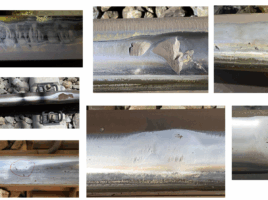
Squat-type Defect Mitigation on Sound Transit and The Search for Effective Preventive Maintenance Measures

October 7, 2023 | Filed under: Milling, Rail Defects, Rail Grinding

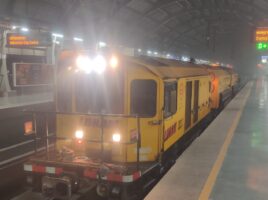
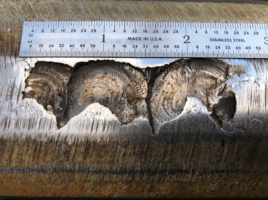
by Jeff Tuzik One of the most vexing, and increasingly common rail defects that rail transit agencies contend with is the squat-type defect (stud). Addressing studs has been challenging in that they are not fully understood, and, while contributing factors are known, the exact root cause(s) are not definitive. “Identifying …

Loram photo2

Quantifying Rail Life Extension with Infinite Rail Grinding Pattern Control

September 7, 2023 | Filed under: Rail Grinding, Rail Maintenance

by Jeff Tuzik Preventive rail grinding is a well-established practice for extending rail life. And by optimizing wheel/rail interaction and controlling the development and growth of surface damage like rolling contact fatigue, rail grinding has proven itself to be one of the industry’s best tools for managing one of its …

Worth awd2

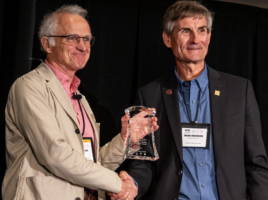
Gary Wolf is the recipient of Wheel Rail Seminars’ 2023 Worth Award

September 3, 2023 | Filed under: WRI Conference

by Bob Tuzik Gary Wolf, president of Wolf Railway Consulting, is the recipient of the 2023 Worth Award. The award, presented by Wheel Rail Seminars at the annual Wheel/Rail Interaction conference in June, is named for Art Worth, who was Manager of Standards and retired as Senior Manager – Advanced …

Instrumented diamond with UTPs

Under-Tie Pads: Resilient Materials Make an Impact

September 2, 2023 | Filed under: Ballast, Heavy Haul, Vehicle/Track

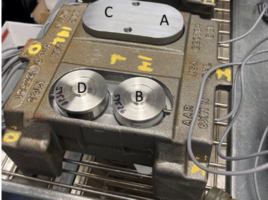
by Jeff Tuzik Areas of track that are subject to high impacts and dynamic loadings, such as turnouts, diamond crossings and other special trackwork, bridges and bridge approaches, high-degree curves, and highway/rail grade crossings are challenging to manage. Maintenance requires attention, resources, and significant ongoing investment. With more than 30,000 …

Compress

Managing Slack in Trains with Cars Equipped with Hydraulic End-of-Car-Cushioning Devices

July 24, 2023 | Filed under: In-Train Forces

by Jeff Tuzik Among the most significant forces that freight railroads contend with in daily operations are buff and draft (or compressive and tensile) forces between cars within train consists. These forces are mediated by various damping technologies, braking and acceleration practices, and by train make-up. When these forces aren’t …

TOR applicator

Developments in Top of Rail and Gage Face Friction Management Consumables

June 2, 2023 | Filed under: Friction Management

New all-season TOR and GF FM products show performance and efficiency benefits over traditional seasonal variants.

Noise rad model

Sound Transit Studies Wheel/Rail Interaction Differences Between Vehicle Types

April 23, 2023 | Filed under: Rail Transit, Vehicle/Track, Wheel Maintenance, Wheel/Rail Interaction

by Jeff Tuzik Seattle’s Link Light Rail, operated by Sound Transit, is a fairly young system. And by most standards, a small system. But it’s also a sophisticated system, and it’s growing fast. The system currently operates 25 miles of track and is in the midst of expanding to 50 …

Depreciation workflow

Quantifying The Value of Maintenance for Asset Management and Capital Planning

March 30, 2023 | Filed under: Big Data, Heavy Haul, Maintenance

By Jeff Tuzik On freight railroads, rail is generally the largest single asset, capital expenditure, and one of the primary costs. From a maintenance perspective, rail is subject to wear and defect development, both of which can be actively managed in a number of ways. From an accounting perspective, rail …

Joe Kalousec (left) and Gordon Bachinsky (right)

Steel Hardness and Wear at the Wheel/Rail Interface: Perception vs Reality

February 6, 2023 | Filed under: Heavy Haul, Rail Maintenance, Wheel/Rail Interaction

By Jeff Tuzik Railroads around the world have many standards for wheel and rail hardness, with varied theories regarding the interaction of harder and softer steels. And while it is intuitively apparent that harder materials should wear less, last longer and generally provide a net benefit to systemic resilience, the …

Trans2 feat

Maintenance Optimization and The State of Good Repair

December 16, 2022 | Filed under: Maintenance, Simulation

By Jeff Tuzik The State of Good Repair is a goal, but it’s also a process. It’s achieved through a series of instruments and instrumental decisions that aim to report on the health of a system from the most granular component level, to the broadest holistic overview. This Part 2 …

← Previous Page
Next Page →

Search by Category

Related Articles

  • WRI 2017 – Transit: System Optimization and Better Asset Management
    In relation to
    Rail Transit
  • WRI 2015: Transit — Maintenance and the State of Good Repair
    In relation to
    Friction Management
  • Engineering the Wheel/Rail Interface for Rail Transit
    In relation to
    Rail Transit
  • Friction Management: Implementation and State of Good Repair
    In relation to
    Friction Management
  • Examining wheel/rail interaction on rail transit systems
    In relation to
    Friction Management

Sponsors

ENSCO
Hollandlogo

© 2026 Interface Journal


Loading Comments...