Interface Journal
The Journal of Wheel/Rail Interaction
Interface Journal
Navigation
  • Home
  • About Interface
  • Contact
  • Wheel Rail Seminars
  • Advertisement & Sponsorship
You are here: Home › Page 7
Depreciation workflow

Quantifying The Value of Maintenance for Asset Management and Capital Planning

March 30, 2023 | Filed under: Big Data, Heavy Haul, Maintenance

By Jeff Tuzik On freight railroads, rail is generally the largest single asset, capital expenditure, and one of the primary costs. From a maintenance perspective, rail is subject to wear and defect development, both of which can be actively managed in a number of ways. From an accounting perspective, rail …

Joe Kalousec (left) and Gordon Bachinsky (right)

Steel Hardness and Wear at the Wheel/Rail Interface: Perception vs Reality

February 6, 2023 | Filed under: Heavy Haul, Rail Maintenance, Wheel/Rail Interaction

By Jeff Tuzik Railroads around the world have many standards for wheel and rail hardness, with varied theories regarding the interaction of harder and softer steels. And while it is intuitively apparent that harder materials should wear less, last longer and generally provide a net benefit to systemic resilience, the …

Trans2 feat

Maintenance Optimization and The State of Good Repair

December 16, 2022 | Filed under: Maintenance, Simulation

By Jeff Tuzik The State of Good Repair is a goal, but it’s also a process. It’s achieved through a series of instruments and instrumental decisions that aim to report on the health of a system from the most granular component level, to the broadest holistic overview. This Part 2 …

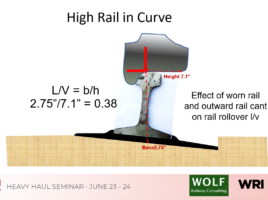
High rail

Using Derailment Findings to Identify Derailment Risks

November 15, 2022 | Filed under: Derailment, Heavy Haul, Measurement Systems

Presenters at the 2022 Wheel/Rail Interaction conference looked at heat and track configuration issues as they relate to derailment potential in heavy-grade, high-tonnage territory. They also looked at the role of Operating parameters in derailment potential, and at the findings from 20 years of investigations into derailments. By Bob Tuzik …

5attention

Understanding the Role of Human Factors in Railway Inspection

November 14, 2022 | Filed under: Maintenance

Presenting experts at Wheel/Rail Interaction 2022 made it clear that there’s more to inspection than meets the eye. Education and training can help reduce errors and improve inspection efficiency. By Bob Tuzik “Human Factors” are frequently cited as cause codes in railway incidents and derailments. But while track and mechanical …

Stud example

The Tools of Remediation: Case Studies on Mitigating Common Concerns at the Wheel/Rail Interface.

September 15, 2022 | Filed under: Friction Management, Maintenance, Noise and Vibration, Wheel/Rail Interaction

by Jeff Tuzik Transit systems around the world, despite their differences, all contend with the same issues to some degree. Issues like vehicle- and ground-borne vibrations, excess noise, and timetable delays often rise in priority as they generate increasing numbers of complaints. These issues are often symptoms that can be …

Cap1

Examining Autonomous Track Geometry Testing and Instrumented Revenue Vehicle Technology

September 7, 2022 | Filed under: Friction Management, Measurement Systems, Noise and Vibration, Rail Transit, Wheel/Rail Interaction

A pair of speakers from different continents discuss the benefits of autonomous track geometry collection and the advantages of monitoring revenue-service vehicles’ response to track conditions in this first installment of topics covered at this year’s annual Wheel/Rail Interaction Conference in Vancouver, B.C., Canada. By Bob Tuzik Brad Kerchof wasted …

Wolf book cover

“The Complete Field Guide to Modern Derailment Investigation:” An insiders’ look into the definitive work by the industry’s preeminent derailment investigator.

April 27, 2021 | Filed under: Derailment, Rail Defects, Track Geometry, Vehicle/Track, Wheel/Rail Interaction

by Bob Tuzik, Executive Program Director – Wheel Rail Seminars If there are lessons to be learned from a derailment — and, of course, there are — then Gary Wolf’s The Complete Field Guide to Modern Derailment Investigation is a master class on finding, analyzing, and understanding the marks on …

Lester1.2

Running Longer Trains More Productively and Less Destructively

March 12, 2020 | Filed under: Heavy Haul, Vehicle/Track

by David C. Lester Dave Peltz is literally a rocket scientist. Although he is now Chief of Global Technology for GE Transportation’s (now Wabtec’s) Intelligent Control Systems Division in Melbourne, Fla., he spent time with the U.S. Air Force as a satellite communications systems engineer for the Mill Star satellite …

Picture4

Moving to Performance-Based Automated Track Inspection: The Benefits and Hurdles Ahead

March 1, 2020 | Filed under: Heavy Haul, Measurement Systems

By David C. Lester The mileage of individual Class 1 railroad networks presents a challenge to inspectors and engineers to inspect frequently enough to keep the track in good shape and minimize the frequency of track-related derailments. Traditional inspections done by railbound geometry cars and flexible hi-rail trucks, with the …

← Previous Page
Next Page →

Search by Category

Related Articles

  • Using Performance-Based Assessment of Reserve Gauge Strength to Enhance Tie-Replacement Planning
    In relation to
    Track Geometry
  • Measuring and Designing Rate of Change in Track Alignment
    In relation to
    Rail Maintenance
  • Autonomous Inspection on CPKC and the Future of Track Inspection
    In relation to
    Autonomous Inspection
  • Examining Autonomous Track Geometry Testing and Instrumented Revenue Vehicle Technology
    In relation to
    Friction Management
  • WRI 2014 Transit: A Systems Approach to Wheel/Rail Interaction
    In relation to
    Friction Management

Sponsors

ENSCO
Hollandlogo

© 2026 Interface Journal

Loading Comments...