Interface Journal
The Journal of Wheel/Rail Interaction
Interface Journal
Navigation
  • Home
  • About Interface
  • Contact
  • Wheel Rail Seminars
  • Advertisement & Sponsorship
You are here: Home › Page 14

Controlling Friction on Rail Transit Systems

January 3, 2014 | Filed under: Friction Management, Rail Transit

By Bob Tuzik • January, 2007 Friction control plays a major role in reducing wear, noise and vibration, and managing wheel/rail interaction on rail transit systems. Controlling friction has become more achievable with the advent of engineered friction modifiers and improvements to wayside and onboard application systems for both traditional lubricants …

Introducing Low-Floor Vehicles into Older Transit Systems

January 3, 2014 | Filed under: Rail Transit, Vehicle/Track

By Roy E. Smith • March, 2006 The introduction of new, low-floor vehicles into existing North American transit systems has provided an attractive means of meeting current operating requirements. By the same token, their introduction has created a number of vehicle/track compatibility issues—particularly when these modern cars are introduced into older …

Testing Railway Vehicles to Improve Vehicle/Track Interaction

January 3, 2014 | Filed under: Vehicle/Track

By Robert Masar • March, 2006 Significant increases in high-speed international traffic throughout Europe have led European railways to establish new comprehensive technical rules to ensure acceptable parameters for vehicle/track interaction. Current measuring systems and data collection and processing capabilities have made it possible to test and homologate new railway vehicles …

The What, Where, Why and How of Rail Grinding

January 3, 2014 | Filed under: Rail Grinding

The Art and Science of Rail Grinding, by Allan M. Zarembski Book review by Bob Tuzik • March, 2006 If you’re like me, your filing cabinet is stuffed with articles from various publications. If you’re organized, you may have a specific folder or binder with articles on rail grinding clipped …

Curve Superelevation: Problems and Solutions

January 3, 2014 | Filed under: Rail Maintenance, Track Geometry, Vehicle/Track

By Gary Wolf • January, 2006 Railroad engineering managers have been struggling with the problem of how much elevation to place in a curve since the first steam engines started turning a wheel. While the physics and calculus of the matter seem straightforward, the application of those formulas is where problems …

Figure 1

Operating at High Cant Deficiency

January 3, 2014 | Filed under: Rail Cant, Vehicle/Track

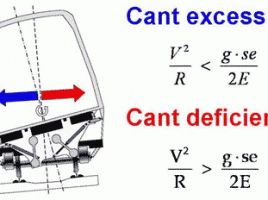
by Peter Klauser • October 2005 Cant deficiency has a significant effect on curving performance of vehicles in both passenger and freight service. The forces due to centrifugal acceleration through a curve must ultimately be reacted at the wheel/rail interface. Curve lateral acceleration and the compensating effect of track superelevation can …

The truck bolster bowl: Is it a bowl or a bearing?

January 3, 2014 | Filed under: Vehicle Design

by Gary Wolf • October 2005 Like many aspects of the three-piece truck, performance issues surrounding the truck bolster bowl and body centerplate are often misunderstood. One of the biggest misunderstandings is that the bolster bowl is actually a bearing. Years ago at a meeting where truck performances issues were …

Lead

Implementing an Anti-Shelling Wheel Profile

January 3, 2014 | Filed under: Wheel Maintenance, Wheel/Rail Profile

By Rob Caldwell • October, 2005 Wheel Shelling has presented serious problems on Canadian railroads in recent years, particularly in winter months. Tread shelling on wheels on Quebec Cartier Mining (QCM) railway’s heavy-haul fleet, for example, reached condemnable limits within one year of use, during the early 1990s. In some cases, …

Making the Case for Long Travel Constant Contact Side Bearings

January 3, 2014 | Filed under: Vehicle Design, Vehicle/Track

by Bill O’Donnell • July 4, 2005 As part of its efforts to reduce the stress state on North American railroads, the Association of American Railroads (AAR) mandated that all new cars ordered after January 1, 2002, must be equipped with constant contact side bearings. Constant contact side bearings (CCSBs) raise the threshold …

FRA Initiatives: Dr. Magdy El-Sibaie, Chief of FRA’s Track Research Division

January 3, 2014 | Filed under: Maintenance, Measurement Systems, Track Geometry, Vehicle/Track

By Bob Tuzik • May 26, 2005 The Federal Railroad Administration’s Office of Research and Development is not the best known R&D organization in the industry, but it is one of the most important. It’s work figures prominently in rulemaking and the regulatory process for the industry. That role is …

← Previous Page
Next Page →

Search by Category

Related Articles

  • Gary Wolf is the recipient of Wheel Rail Seminars’ 2023 Worth Award
    In relation to
    WRI Conference
  • Examining Autonomous Track Geometry Testing and Instrumented Revenue Vehicle Technology
    In relation to
    Friction Management
  • Wheel/Rail Interaction ’08: Data to Information (Part 2 of 2)
    In relation to
    Friction Management
  • Designing Amtrak’s Wayside Train/Track Interaction Detection System
    In relation to
    Measurement Systems
  • Rail Cant Measurement of Concrete Crossties (Part 2 of 2)
    In relation to
    Measurement Systems

Sponsors

ENSCO
Hollandlogo

© 2026 Interface Journal

Loading Comments...