
Bridging the Gap Between Research, Education and Best Practices: A Conversation with an Industry Expert on Managing Wheel/Rail Interaction
by Jeff Tuzik
It’s not every day that you get to sit with a legend to ruminate on the state of your segment of the industry. Interface Journal editor Bob Tuzik was able to do just that—to sit down for a fireside chat of sorts with Gary Wolf the industry’s foremost derailment investigator, trainer, educator, and author of The Complete Field Guide to Modern Derailment Investigation, the definitive tome on the subject.
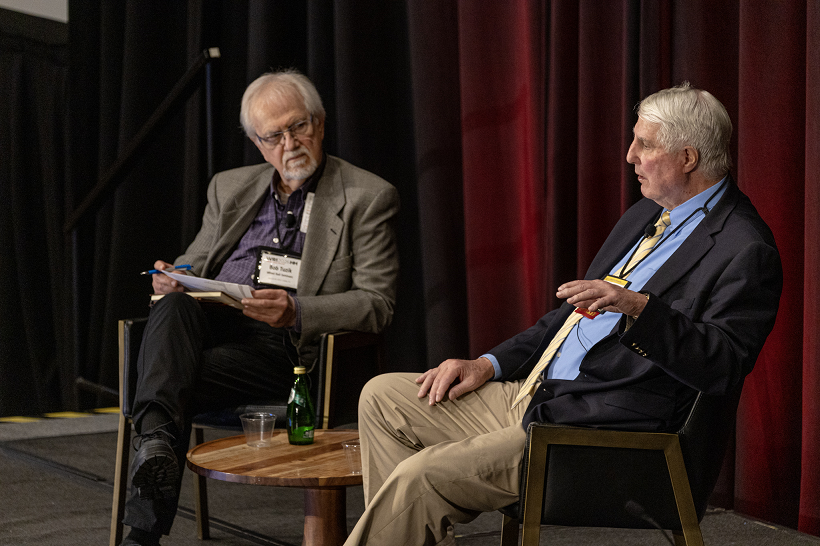
The conversation, which took place at the 2026 Wheel/Rail Interaction Heavy Haul conference, zeroed in on some of the salient issues relating to wheel/rail / vehicle/track interaction and how railways and regulators deal with them, for better or for worse. Wolf, a 56-year industry veteran, and longtime participant in the Wheel/Rail Interaction Conferences and recipient of WRI’s Worth Award, who is known for not pulling his punches, started by saying, “If I were to give the industry a score on wheel/rail management, I’d give it a C+.” While the understanding and application of the principles of wheel/rail interaction has improved over the years, he said, “there’s a lot of potential out there that we haven’t taken advantage of.”
The industry has struggled historically to bridge the gap between research, academic education, best practices, and the knowledge and education of the people in the field who actually plan and perform maintenance,” Wolf said. “The more we can do to understand what goes on out there, the better. Toward that end, “the WRI conference provides a forum with a good balance between research, academic work, and good, practical railway knowledge.” And the topics covered at the conference align well with his area of work and expertise in wheel/rail interaction, vehicle dynamics, derailment investigation, and training.
“One of the things we’ve consistently hammered on at the conference is that the wheel/rail interface is and must be viewed and treated as a system,” Tuzik said. “Do you see it being treated that way in the industry?”
“The short answer is no,” Wolf said. “It’s managed at every railway in different silos. Not a single railway has a director or manager of wheel/rail interface. But we know, or should know, that you can’t manage a system by only managing some of the components. Siloed operations and management often result in conditions that may appear to benefit one department, or silo, but may actually degrade the overall system.” Friction management is a case in point.
“What we do in wheel/rail management is forward-looking stuff. […] Unfortunately, railroads are looking quarter to quarter.”
Typically, the track department installs, maintains, and buys lubricants. But benefits accrue to track, mechanical, and transportation departments in the form of reduced rail and wheel wear, fuel consumption, and a reduction in forces transmitted to the rest of the track and vehicle components, Wolf said. “By looking only at the benefits that accrue to the track department can make it difficult to justify the cost of lubrication. But add all the benefits together and it’s a no-brainer.”
“What are some of the other hurdles to treating the wheel/rail interface or vehicle/track interaction more broadly as a system?” Tuzik asked.
The free interchange of cars on Class 1s is one of the biggest hurdles to managing wheel/rail interaction; it effectively creates an additional “silo” that operates outside of the Class 1 economic system, Wolf said. “Railroads own the track, shippers and car owners own the cars. There is no economic incentive for car owners to care about damage done by vehicles to the track or vice versa. We need to develop a system where both sides are incentivized to perform at a high level.”
There are some mechanisms in place to help level the playing field. The mechanical department can, for example, inspect and repair a poorly steering truck flagged by a Truck Performance Detector (TPD). Corrective actions might include side bearing adjustment, centerbowl lubrication, or wedge rise correction. “This helps prevent further track damage, Wolf said. “In this case, some of the repair burden is shared by the car owner.”

On the flip side, readings from diagnostic tools such as TPDs also illustrate the chasm and resulting friction between railroads and car owners. “TPDs can identify poorly steering trucks, but it is up to a mechanic to determine why the truck steers poorly,” he said. If there is no AAR defect to report, the truck’s poor performance is likely to be a combination of under-threshold wear and defect levels. “The mechanic doesn’t know what to fix, so the truck goes back out and maybe somewhere down the line causes a derailment,” Wolf said. “Or at the least, the truck causes accelerated wheel and rail wear. We lack clear cut mechanical standards and economic incentives to correct poorly steering trucks.”
“You’ve seen rail grinding develop and transform rail maintenance over your career.” Tuzik said. “That’s been a big win for wheel/rail management, hasn’t it?”
“There are two primary benefits to grinding: improving asset life and preventing derailments. Any improvement in asset life is money in the bank,” Wolf said. Railroads use various criteria for grinding. Some base their grinding cycles on recorded and/or historical wear data. Some measure rolling contact fatigue damage as an additional criterion. Some railroads are still in a corrective grinding mode, fixing damage done by years of deferred maintenance, but many others are in a cyclical preventive grinding mode. “Grinding management has come a long way, but it’s still hit or miss at some railroads,” he said. “Grinding is, after all, a budget item, and it can be deferred or cut if the numbers don’t look good. Unfortunately, such short-term gains often come with long-term consequences.
“What we do in wheel/rail management is forward-looking stuff. We extend rail life 25 years in the future. We prevent derailments eight years in future. Unfortunately, railroads are looking quarter to quarter,” Wolf said. This mindset can and does lead to deferred maintenance, saving a small amount of money in the near term in exchange for potentially catastrophic costs in the future. “Track degrades very quickly. And it’s a hell of a lot easier to maintain good track than to fix bad track.”
Derailments are another story. For the past 15 years, the derailment rate per million train miles has effectively been flat, Wolf said. “For a safety-critical industry like ours, that’s unacceptable.” Looking only at broken-rail derailments, the only cause that is trending upward over that period is detail fractures. These are generally caused by a lack of grinding, a lack of lubrication, and excessive gage-corner stresses. “It’s a sign that rail grinding hasn’t lived up to its potential as a derailment-prevention tool.”
“Beyond rail grinding, you would think that the dramatic improvements in inspection technology would have had a measurable effect on the number of derailments,” Tuzik said. “Why haven’t the number of derailments decreased?”
“This is the big question,” Wolf said. “And like most big questions, there is no simple answer. “A big part of it is that we’re not drilling down to root causes, he said. The cause code T110/111 for wide gage, for example, is the most frequently used cause code; it’s used in roughly 20% of all FRA reported derailments. But there are many potential causes of wide gage; there can be track, mechanical, and/or operational root causes. If a wide-gage derailment is identified as a track-related cause code, but the wide gage was actually caused by a stiff truck, then nothing is learned, and nothing is fixed, he said. “That stiff truck is going to go out and cause another derailment somewhere else. And they’ll call it wide gage again.”
“It’s a hell of a lot easier to maintain good track than to fix bad track.”
Cause codes themselves are part of the problem, Wolf said. “We’re using the same cause codes that we started with 50 years ago. The whole thing needs to be revamped.” Another example is cause code T109 — buckled track. It too has become a catch-all. There are a dozen possible causes for a track-buckle. “Characterizing all of them with a single cause code doesn’t get to the root cause.” The “H” or “human failure” cause codes are similarly unhelpful. “None of them are causes. They’re just descriptions of what occurred. They don’t tell you how or why.”
The shortcomings of the cause codes start with the regulator, the Federal Railroad Administration, and ripple through the railroads and their derailment investigations. While the FRA is responsible for the catalogue of cause codes, the FRA is not responsible for derailment investigation. Railroads are responsible for conducting derailment investigations and ensuring that the information they present to the FRA on the cause of the derailment is accurate. But, again, the cause codes we have don’t allow us to drill down like we need to find root causes,” Wolf said.
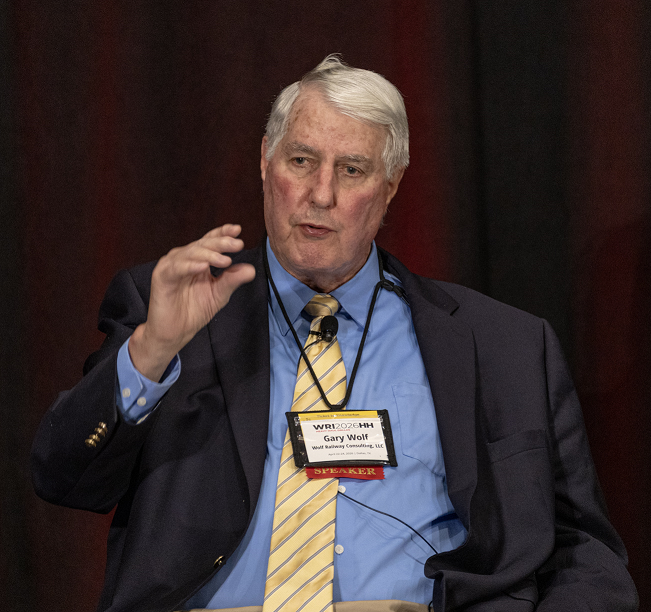
Beyond that, the rapid turnover in management and a lack of specific derailment-investigation training has led to a situation where railroads may lack the expertise to effectively perform investigations themselves, he said.
“Speaking of regulation, what are your thoughts on the ATIP waivers, going forward?” Tuzik asked.
“Well, I’m happy to see that the FRA has reinstated the waiver process for automated track inspection. It’s a step in the right direction,” Wolf said. However, the ATIP waiver only provides modest relief from mandated hi-rail inspection, and it includes a burdensome paperwork and reporting requirement.
In addition to encouraging automated track inspection, Wolf said that he’d also like to see the FRA take a more proactive approach to updating the federal 213 Track Safety Standards. He’d like to see:
- Codification of “combination causes” in which multiple non-condemnable defects are clustered together. The current standard specifically refers to “track conditions existing in isolation,” which means that clustered non-condemnable defects are not flagged, despite being problematic.
- A reexamination of current 62- or 31-foot chord length used in track geometry standards. “When these standards were designed in the 70s, we had 50-foot box cars. Now we have 85-foot center beams, 250-foot well cars, and such. Maybe we should we be looking at a different chord length?
- Better clarity on managing CWR, particularly on regional railroads and shortlines. Rail neutral temperature will have regional variance, but the way CWR is laid, adjusted, and anchored should be standardized across all railroads, he said.
- A standard for rail cant in curves. “I see a lot of excessive cant in curves that nobody does anything about. That’s how you set yourself up for a rail rollover,” he said.
More clarity and specificity in standards and cause codes will benefit the railroad and the regulator and will help drive derailment rates down, Wolf said. Lowering derailment rates will also require organizational and operational changes within the railroads. Human failure-caused derailments are now the most common type of derailment, having surpassed track-caused derailments. “As I said earlier, we can’t just call the derailment a human failure and go home. We have to drill down to the root causes. Why did the human do what they did? What systems, or lack of systems, allowed it to happen?”
While it’s clear that there is no shortage of challenges facing the industry from a wheel/rail management and derailment prevention perspective, Wolf frames them as opportunities for the industry to improve. “There is potential to be a safer, more reliable, and more profitable industry. But some changes are needed,” he said. “If we keep doing the same things, we’ll keep getting the same results.”

Jeff Tuzik is Managing Editor of Interface Journal.
This article is based on a presentation made at the 2026 Wheel/Rail Interaction Heavy Haul conference.